
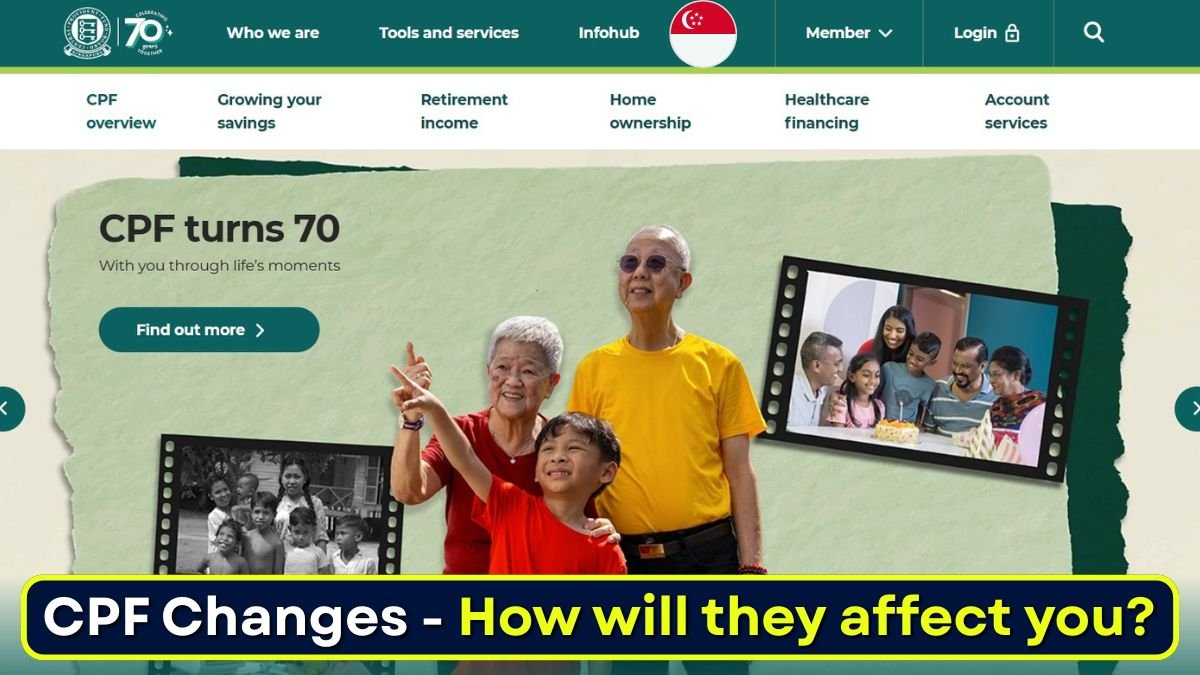
KEY HIGHLIGHTS
- CPF monthly salary ceiling rises to S$8,000 from 1 January 2026.
- Higher CPF deductions for those earning above S$7,400, but bigger retirement savings.
- Senior workers aged 55–65 will also see higher CPF contribution rates.
If your monthly pay is creeping past S$7,400, or you’re above 55, this one matters. From 1 January 2026, CPF rules will shift again — and yes, your take-home pay may change.
This is the final step of the CPF adjustment that started back in September 2023. The goal? Help Singaporeans build stronger retirement savings, even if it stings a bit in the short term.
At the centre of it all is the CPF monthly salary ceiling — and it’s about to hit its final target.
What exactly is changing in 2026?
From 1 January 2026, the CPF monthly salary ceiling increases from S$7,400 to S$8,000. This means CPF contributions will apply to a larger portion of your monthly income.
In simple terms: if you earn more than S$8,000 a month, the excess above that amount still won’t attract CPF. But if you’re between S$7,400 and S$8,000, more of your salary will now be CPF-deductible.
There’s no change to the CPF annual salary ceiling, which stays at S$102,000, and the CPF annual contribution cap remains S$37,740.
CPF Monthly Salary Ceiling timeline
| Period | Monthly Salary Ceiling | Increase |
|---|---|---|
| Before 1 Sep 2023 | S$6,000 | – |
| From 1 Sep 2023 | S$6,300 | + S$300 |
| From 1 Jan 2024 | S$6,800 | + S$500 |
| From 1 Jan 2025 | S$7,400 | + S$600 |
| From 1 Jan 2026 | S$8,000 | + S$600 |
Who feels the impact the most?
Two groups of workers should pay close attention.
First, higher-income earners. If your monthly salary is above S$7,400, your CPF deductions will go up in 2026.

Second, senior workers aged above 55 to 65. Even if your salary isn’t high, CPF contribution rates for this age group will rise to boost retirement adequacy, as long as you earn more than S$750 a month.
If you fall into both categories — above 55 and earning more than S$7,400 — you’ll feel both changes at the same time.
How will this affect your take-home pay?
For workers aged 55 and below, CPF contribution rates stay the same at 20% employee and 17% employer. What changes is the salary amount CPF applies to.
Example time.
If you earn S$8,000 a month:
- 2025: CPF employee contribution = S$1,480 (20% of S$7,400)
- 2026: CPF employee contribution = S$1,600 (20% of S$8,000)
That’s S$120 less take-home pay every month, or S$1,440 a year.
Here’s how CPF contributions have stacked up over the years:
| Period | Employee CPF (20%) | Employer CPF (17%) | Total CPF |
|---|---|---|---|
| Before Sep 2023 (S$6,000) | S$1,200 | S$1,020 | S$2,220 |
| Jan 2025 (S$7,400) | S$1,480 | S$1,258 | S$2,738 |
| Jan 2026 (S$8,000) | S$1,600 | S$1,360 | S$2,960 |
Assumes employee aged 55 and below.
Extra changes for senior workers (55–65)
From 1 January 2026, CPF contribution rates for workers aged above 55 to 65 increase by a combined 1.5%.
- Employer contributes 0.5% more
- Employee contributes 1% more
All additional contributions go into the Retirement Account (RA), up to the Full Retirement Sum.
Example
If you’re 58 years old earning S$5,000:
- 2025: Employee CPF = 17% (S$850)
- 2026: Employee CPF = 18% (S$900)
That’s S$50 less take-home pay, but more money locked in for future CPF LIFE payouts.
Does this actually help your CPF savings?
Short answer: yes, quite a bit — especially over time.
If you earn S$8,000 a month, the full 2026 changes mean:
- + S$400 employee CPF per month
- + S$340 employer CPF per month
That’s S$740 more every month, or S$8,880 a year, going into your CPF accounts.
Over a long career, this adds up fast. Based on a simplified illustration of a 30-year-old earning S$8,000, the higher CPF ceiling can result in over S$200,000 more in CPF contributions by age 55, even before interest is considered.

And remember — CPF still earns at least 2.5% interest, so compounding does the heavy lifting quietly in the background.
So… worth it or not?
Honestly speaking, your take-home pay will dip if you’re affected. No sugar-coating that.
But for most Singaporeans, this is forced saving that directly strengthens retirement income — especially for those who might otherwise under-save. For older workers, the boost to the Retirement Account helps you reach the Full Retirement Sum faster, which means higher CPF LIFE payouts later.
No need to panic. Just be aware, plan your cash flow properly, and let CPF do what it’s designed to do.
Frequently Asked Questions
1. Will everyone pay more CPF in 2026?
No. Only employees earning above S$7,400 a month or those aged 55–65 (with higher contribution rates) will see changes.
2. Is the CPF annual cap increasing as well?
No. The CPF annual salary ceiling stays at S$102,000, and the annual contribution limit remains S$37,740.
3. Can I avoid the impact on take-home pay?
Not really. CPF contributions are mandatory. But you can plan better by adjusting expenses or using CPF strategies like OA-to-SA transfers if suitable.
Sources & further reading (key references)
- CIMB Singapore — online SGD FD promotion page (Dec 2025). CIMB Singapore
- Maybank Singapore — SGD time deposit promotions (Dec 2025). Maybank Singapore+1
- UOB — Singapore dollar time fixed deposit rates & promotions (Dec 2025). United Overseas Bank+1
- OCBC — Time Deposit product pages & internet banking promos (Dec 2025). OCBC Bank+1
- HSBC Singapore — SGD time deposit promotions (Dec 2025). HSBC SG+1
- MoneySmart / SingSaver comparative articles (Dec 2025) summarising top FD promos across banks. MoneySmart+1
- Reuters — MAS policy easing, Jan 24, 2025 (context on monetary policy influence). Reuters

 Join
Join